.webp) playverdicth5.com
playverdicth5.comStardew Valley: A Deep Analysis of the First Spring Economy and How Daily Time Management Shapes Your Entire Farm
Introduction
Stardew Valley is often described as a relaxing farming game where players grow crops, raise animals, fish, mine, build relationships, and gradually restore their farm. However, beneath its peaceful atmosphere is a surprisingly demanding economic system built around one of the game's most limited resources: time. Every in-game day has a fixed number of hours, and the decisions made during the first Spring can have consequences that continue throughout the entire first year.
The first Spring is particularly important because players begin with limited money, basic tools, a small amount of land, and almost no established infrastructure. The farm needs to generate income, but expanding too quickly can consume valuable energy and time. At the same time, ignoring other activities such as fishing, foraging, mining, and social relationships can delay future progression. The challenge is therefore not simply to earn as much gold as possible. It is to determine how each hour should be converted into long-term value.
Day One: The First Economic Decision Begins Before the First Crop Is Planted
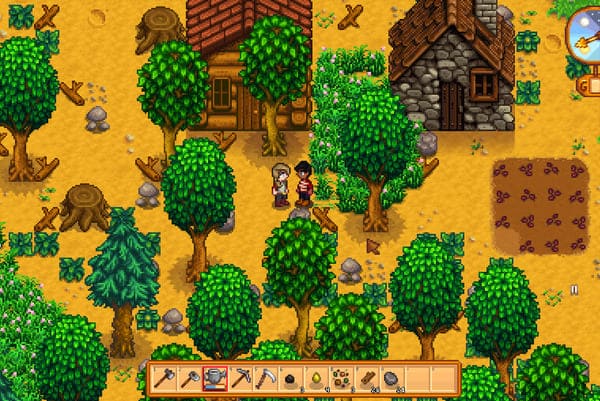
The first day on the farm is deceptively important. Players receive basic tools and a small amount of starting money, but the farm itself is covered with debris. Trees, weeds, stones, and branches occupy valuable space, creating an immediate temptation to clean everything. However, clearing the entire farm on Day One is rarely the best use of time and energy.
The first economic decision is therefore not "What should I plant?" but "What should I leave untouched?" Clearing only the area required for an initial crop field allows the player to preserve energy for activities that produce immediate value. The objective is to establish a functional production area without spending the entire day performing low-value labor.
The first priorities
The exact order can change depending on the player's goals, but the underlying principle remains the same: early actions should either generate income or unlock future efficiency.
Why over-clearing is inefficient
Every swing of an axe or pickaxe consumes energy. Early in the game, energy is a major constraint because the player has limited food and relatively weak tools. Spending the entire energy bar clearing the farm may leave no energy for fishing or exploration.
This creates an opportunity cost.
If an hour of clearing produces only materials that are not immediately needed, while the same hour could have been spent fishing for early income, the clearing activity may have lower economic value.
The best first-day farm is therefore not necessarily the cleanest farm. It is the farm that creates the strongest foundation for future progress.
The First Week: Establishing a Sustainable Crop Economy
The first week introduces the central economic tension of Spring. Crops provide predictable income, but they require seeds, watering, harvesting, and time. Players must decide how much land to dedicate to farming without creating an unsustainable workload.
A common mistake is to assume that planting more crops always means earning more money. In reality, every additional crop increases daily labor requirements. If the player plants a large field without sufficient energy or upgraded tools, the farm can consume most of each morning.
This reduces the time available for other profitable activities.
Crop quantity versus crop efficiency
A crop that produces a high theoretical profit may not be the best choice if it requires too much daily attention. Similarly, a crop with a lower individual value may become more attractive if it can be harvested multiple times.
The first-week economic balance
During the first week, the player should ideally create a routine in which farming provides a reliable baseline income while another activity supplies additional cash.
For example:
Morning: Water and maintain crops.
Late morning: Fish or forage.
Afternoon: Continue fishing, explore, or gather materials.
Evening: Return home, organize inventory, and prepare for the next day.
This structure allows the farm to develop without turning every day into a repetitive cycle of watering.
The importance of reinvestment
The strongest early economy is one that continuously converts current income into greater future productivity.
The First Rainy Day: Turning Weather Into Economic Advantage
Rain is one of the most valuable events during the first Spring because it changes the normal relationship between time, energy, and farming. Crops do not need to be watered manually, immediately freeing the morning for other activities.
This creates a rare opportunity to spend an entire day on high-value tasks without sacrificing crop maintenance.
What makes a rainy day different?
On a rainy day, those activities disappear.
The economic value of rain therefore extends beyond convenience. It represents a temporary increase in available productive hours.
Choosing between fishing and mining
The best choice depends on the player's immediate needs.
A rainy day should therefore be planned in advance. If the player intends to upgrade a tool, the previous day can be used to prepare materials and money so that the rainy morning becomes maximally productive.
Fishing as the First Spring's Emergency Income Engine
Fishing is one of the most powerful economic tools available during the first Spring because it converts time and skill into direct income without requiring land, seeds, or infrastructure.
Unlike crops, fishing does not require the player to invest money before earning. This makes it particularly valuable when starting capital is limited.
However, fishing has an important limitation: its profitability depends on the player's ability to catch fish consistently.
Fishing versus farming
The two activities operate under different economic models.
This makes fishing an ideal complement to early farming.
A player can plant a manageable number of crops in the morning and spend the remainder of the day fishing. The farm then provides a predictable future harvest while fishing generates immediate cash for reinvestment.
The hidden value of fishing skill
Fishing also creates a long-term advantage. As the player's fishing skill improves, the activity becomes more efficient. The player can catch fish more reliably and gain access to better equipment and opportunities.
This means that early fishing is not merely an income strategy. It is an investment in a skill that can remain valuable beyond the first Spring.
The Mine Opens: Balancing Immediate Profit Against Future Infrastructure
Once mining becomes accessible, the first Spring economy becomes more complicated. The mine offers valuable resources, but entering it means sacrificing time that could otherwise be spent fishing or managing the farm.
The key question is whether the player should prioritize immediate income or long-term infrastructure.
Why mining matters economically
The value of mining therefore increases over time.
A player who spends every available hour fishing may become financially wealthy but remain limited by weak tools and insufficient materials. Conversely, a player who mines constantly may have excellent resources but insufficient cash to expand the farm.
The correct solution is not to choose one activity permanently. It is to alternate priorities according to the farm's current bottleneck.
Identifying the bottleneck
Tool Upgrades: The Economic Value of Losing a Day
Tool upgrades are often misunderstood because they temporarily remove an important tool from the player's inventory. This can appear economically inefficient, especially during a busy farming season.
However, the correct question is not how much productivity is lost during the upgrade. The correct question is how much time the improved tool will save over the following weeks and months.
The opportunity cost of upgrading
Suppose a player upgrades a tool and cannot use it for a period of time. That creates an immediate cost.
The upgrade therefore creates a long-term productivity gain.
Choosing the right upgrade timing
The ideal timing depends on the tool and the player's schedule.
A rainy day can be particularly valuable for tool upgrades because crops do not require watering. The player can send the tool for upgrading while using the freed time for fishing, mining, or other activities.
This creates a powerful combination:
Rain + Tool Upgrade = Minimal farming disruption
The player loses access to the tool temporarily but avoids sacrificing an important farming day.
Tool upgrades as time investments
The first Spring should be viewed as a transition from manual labor toward efficiency. Every tool upgrade reduces the amount of time required to perform repetitive tasks.
This means that early spending on upgrades can indirectly increase future income by freeing hours for higher-value activities.
The Middle of Spring: Managing the Snowball Effect
Around the middle of Spring, the player's decisions begin to compound. A player who managed the first two weeks efficiently may now have more money, better tools, improved skills, and a larger crop field.
This creates a snowball effect.
More money allows more seeds.
More seeds create larger harvests.
Larger harvests generate more money.
Better tools reduce labor time.
Reduced labor time creates more opportunities for fishing or mining.
The challenge is preventing this snowball from becoming unstable.
The Last Week of Spring: Planning Around the Seasonal Deadline
The final week of Spring introduces a new economic problem: time is running out.
A crop planted too late may not mature before Summer. This means that the value of a seed depends not only on its selling price but also on the number of days remaining in the season.
The seasonal cutoff problem
This changes the economics of planting dramatically.
A seed purchased near the end of the season may appear inexpensive, but if it cannot produce a harvest before the seasonal transition, the investment may effectively become wasted capital.
The final-week strategy
The last week should focus on converting remaining time into useful long-term value.
The player should avoid making large investments in activities that cannot pay back before Spring ends unless those investments have a clear long-term purpose.
The Final Days: Converting Spring's Progress Into a Summer Advantage
The final days of Spring are not simply the end of the first season. They are the preparation phase for the next economic cycle.
A successful Spring should leave the player with more than gold. The player should also have improved infrastructure, resources, skills, and knowledge.
The ideal end-of-Spring position
The exact balance varies by playstyle, but the important point is that Spring should create momentum.
Preparing before the season changes
The transition between seasons creates a brief economic reset.
The First Spring's Final Lesson: Time Is the Real Currency
The first Spring economy demonstrates a fundamental principle of Stardew Valley: gold is not the only resource that matters. Time is often more valuable because it determines how many opportunities the player can pursue in a single day.
A practical first-Spring framework
The most important concept is flexibility. There is no single perfect daily schedule because the farm's needs change continuously. A good strategy adapts to weather, energy, finances, crop timing, skill progression, and unexpected opportunities.
Conclusion
The first Spring in Stardew Valley is much more than an introductory season. It is a complex economic system in which every day presents a choice between competing opportunities. Farming offers predictable future income, fishing provides immediate cash, mining supplies long-term infrastructure, and tool upgrades convert short-term sacrifice into permanent efficiency.